Katerina Gibson is a writer and bookseller living in Naarm. Her debut collection Women I Know won the 2023 Christina Stead Prize for Fiction, the Steele Rudd Award, and was shortlisted for the Glenda Adams Prize for New Writing. Her stories have appeared in HEAT, Granta, Overland, The Griffith Review, the Lifted Brow, Meanjin, and New Australian Fiction, among other places. Her story ‘Fertile Soil’ was the Pacific region winner of the 2021 Commonwealth Short Story Prize, and was later translated into Italian.
Katerina was named SMH Best Young Australian Novelist in 2023 and 2025. Her debut novel The Temperature was published with Scribner in 2024.
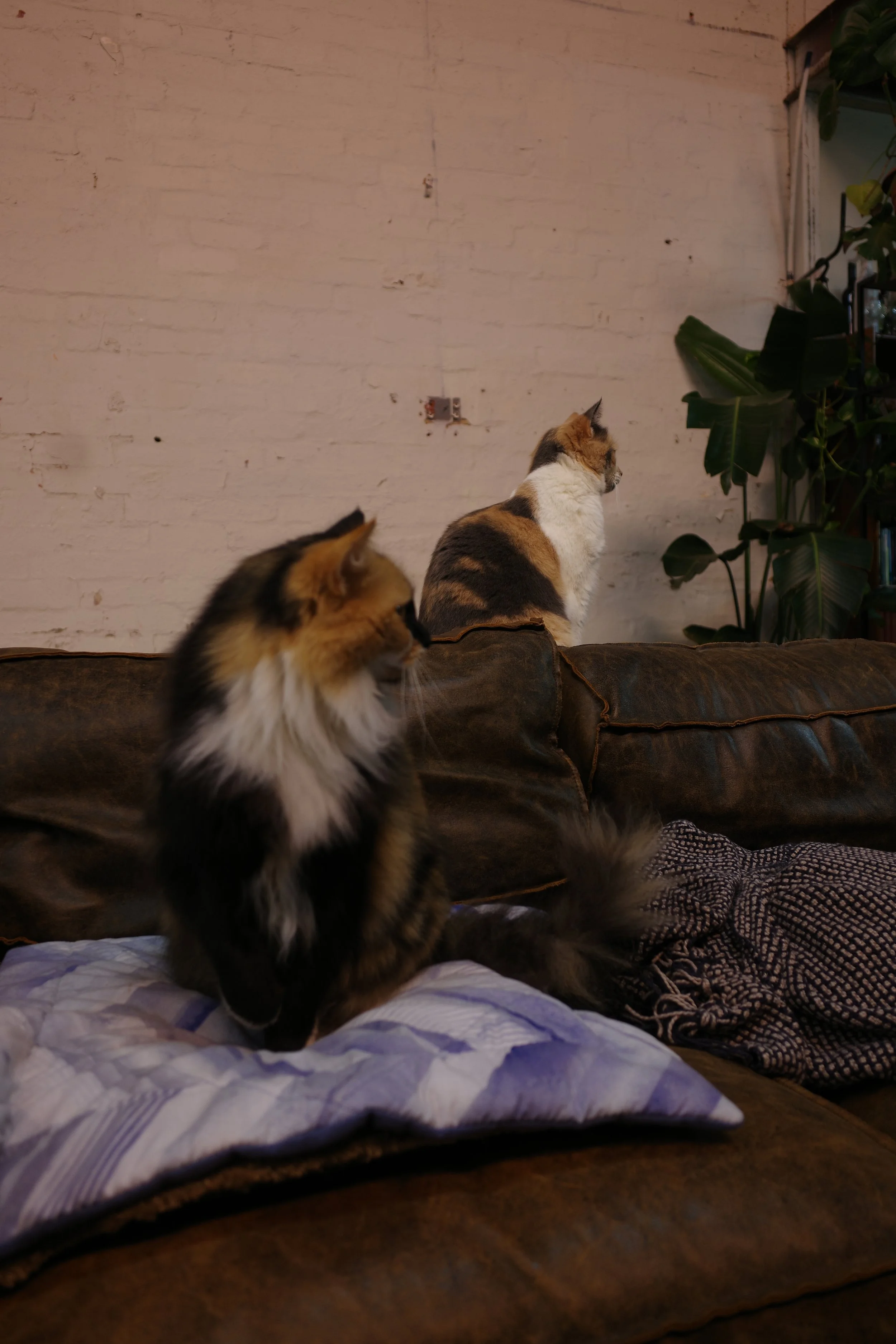
Moose and Tchai (pictured) are our custodians of LOLA and as such, we cannot recommend those of you with allergies study with us.
Pursuing Literature
Advanced in-person Writing workshop
With Katerina Gibson
Term starts August 12, 2026. Advanced writing workshop aimed at emerging writers who want to hone their craft, and expand their literary knowledge. Limited spots available. 8 weeks in person including 8 Wednesday nights classes 6-8 pm and 2 Saturday morning workshops. Pursuing Literature is designed to help develop your ideas and writing skills with an emphasis on both the novel and short story form, with an opportunity to have your work read and workshopped, meet other writers and readers, and receive individualised feedback of up to 6000 words. While the course is dedicated to teaching you how to develop the first chapter of a novel or 1 -2 short stories, there is also an emphasis on reading and appreciating literature, which is to say that it while we will cover publishing opportunities, it is less interested in publishing as an outcome, and more so in honing literary craftsmanship.
Limited spots, with up to one full scholarship position available.
Tuition $860 split payment options available.
To Apply email books@whoislola.org with a brief CV, and writing sample (up to 1000w). Writing sample is optional, but you will not be considered for the scholarship position. Experience unnecessary. Enthusiasm for literature highly encouraged. Scholarship Deadline: Aug 12
Week 1. Wednesday August 12, 6 - 8 pm.Starting a story. We’ll uncover the interesting beginnings, ideas and formulations, with a specific focus on short story and first novel chapters. What intrigues us about our favourite stories?
.Week 2. Wednesday August 19, 6-8 pm.Voice. Point of view, you know the deal. We will look at why it’s important to interrogate and integrate it into our writing.
Week 3. Wednesday August 26, 6-8pm. Saturday August 29, 10-12 am
Week 4 Wed. Sept 2, 6-8 pmDeeper meaning with less. We’ll look at writers who evoke meaning with the lightest touch and how the unsaid remains an important tool amid pressures of endless clarification.
Week 5 Wed. Sept 9, 6-8pmStructure. Discussing how stories hold up, how (and if) to think ahead and why we build scaffolding in our own stories.
Week 6 Wed Sept 16 6-8pmWeek 6 Wednesday September 23rd, 6-8pm. Saturday September 26th, 10-12 am.
Week 7. Wednesday September 30 6-8pmWeek 8. Wednesday October 7 6-8 pm.“Australian” imaginary, place and and beyond. Writing place and positionally. Seeing and not seeing. How to write about belonging and not belonging. We’ll look at representation of place in fiction, and the stories we are (re)writing, consciously and unconsciously.
Workshop Intensive
The esoteric. Why stick to learning the basics when there’s such a rich history of experimentation. This class will be anti minimalism. Experiments (failed and not). The flaneur, the stream of consciousness, changes in perspective and different modes of seeing.
Why write anyway? We will discuss the state of literature, our contribution to it, why it is we want to publish, and how we might go about inhabiting an increasingly scarce and uncertain landscapes (literary and otherwise).
Workshop Intensive
Guest Lecture. TBC
Literature now. We’ll revisit the question of why we write, while considering to our literary fore-writers who continue to push the form, and how dedication to writing and literature can reimagine the way we think and conceive as readers and writers.